
Consultant doctor · Jersey
Who is Dr Rob Greig?
Choosing a clinician is about more than choosing a treatment. It is about knowing who is assessing you, what standards they work to and whether they will put your safety first.
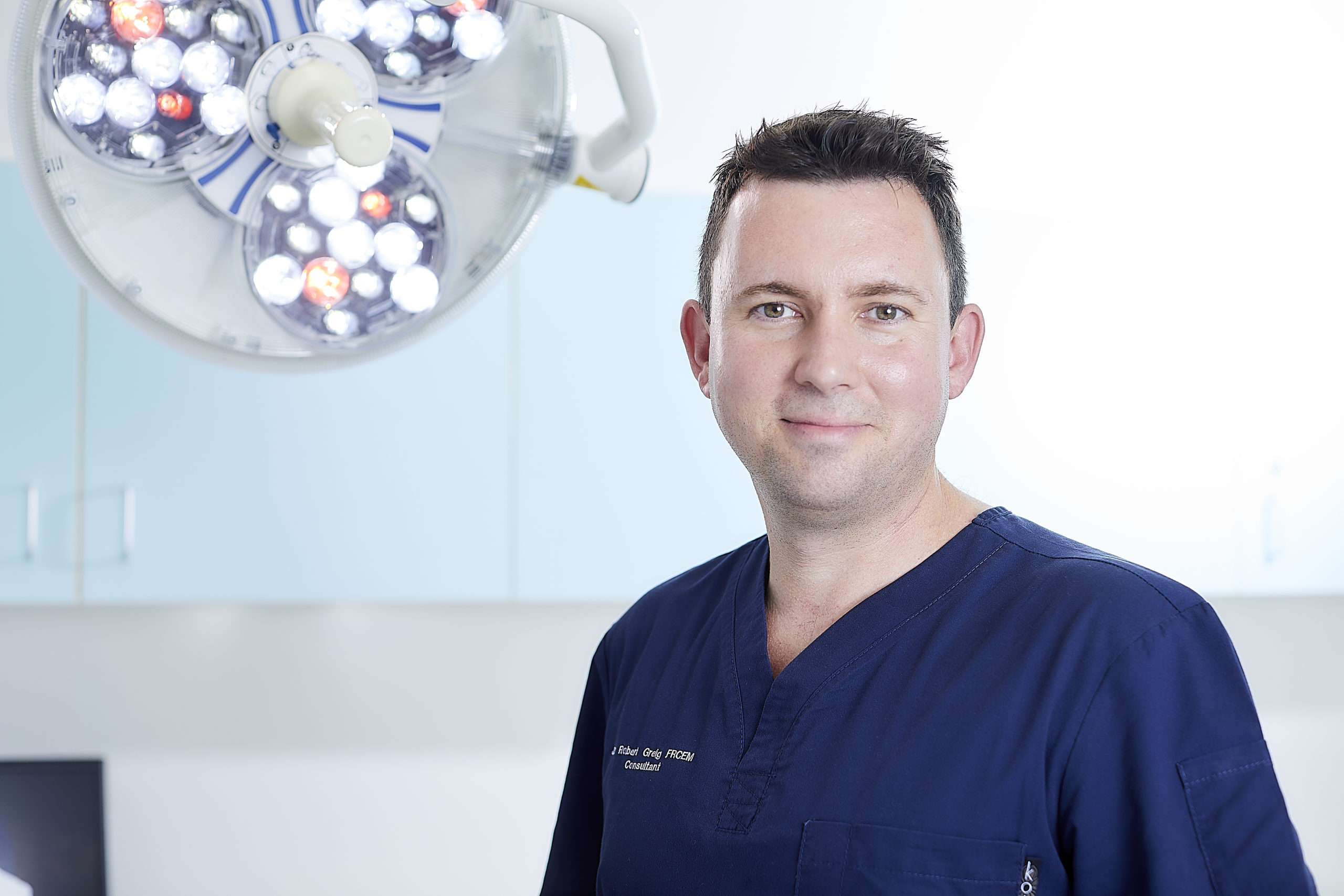
Dr Rob Greig is a Jersey-based consultant doctor with more than 25 years of medical experience. His practice combines personal, consultant-delivered care with the same habits that shape his wider work in clinical governance: careful assessment, evidence, audit and honest communication.
Accountable medical practice
- GMC Specialist Register: 4648541
- Jersey Care Commission registered: JMR/132
- MB ChB, FRCEM
- Annual medical appraisal
- Professional indemnity cover
- Ongoing audit and professional development
Clinical experience
A career built for complex clinical decisions
Becoming a Consultant in Emergency Medicine requires breadth: the ability to assess patients whose diagnosis is not yet clear, recognise risk and draw on experience from many different specialties. Dr Greig’s training and clinical work have included:
Acute and emergency care
- Emergency Medicine
- General and Acute Medicine
- Stroke Medicine
- Disaster Medicine
Surgery and critical care
- General Surgery
- Trauma and Orthopaedic Surgery
- Hand Surgery
- Anaesthesia
- Intensive Care Medicine
Imaging and wider practice
- Point-of-care Ultrasound
- Echocardiography
- General Practice
- Aesthetic Medicine
Contributions and achievements
Improving care beyond the consultation room
Improving care in Jersey
- Introduced island-wide treatment pathways for Deep Vein Thrombosis and Pulmonary Embolism, helping patients receive consistent care across Jersey.
- Authored and contributed to numerous safety guidelines for the Emergency Department and the wider hospital.
- Led the early adoption of Point-of-Care Ultrasound in Jersey, bringing imaging closer to the bedside, improving care and avoiding significant cost for the health service.
Teaching and publishing
- Lectured nationally and internationally on Ultrasound, DVT and anticoagulation.
- Presented at the British Society for Haematology Annual Scientific Meeting in 2021.
- Published work with the Royal College of Emergency Medicine on urological emergencies, intravenous access and wrist-fracture management.
- Contributed to a British military publication on advanced trauma management.
What this experience means for patients
You are being assessed by a consultant accustomed to complex medical histories, safe prescribing, recognising risk, managing uncertainty and knowing when treatment is not appropriate. That experience sits behind every cosmetic and medical weight-management consultation.
Confidence built on evidence
Not vague claims. Documented figures from Dr Greig’s own appraisal, patient feedback and clinical audits.
83
patients completed an anonymised GMC patient survey, with an average survey score of 92%.
100%
of those 83 respondents said they were confident in Dr Greig’s ability to provide their care.
16
colleagues contributed independent feedback in 2025, rating knowledge at 96% and communication at 94%.
Anonymised GMC patient survey · 2023
Historical feedback describes patient and colleague experience; it does not guarantee a particular clinical outcome.
Patient safety work · 2025
Safety is not a slogan—it is my day job
During 2025, Dr Greig’s hospital role expanded across clinical governance, medicines safety, serious-incident investigation and medical policy. The work is separate from his private clinic, but it shapes the standards he brings to every consultation.
Hospital safety-alert lead
Appointed Hospital Lead for National Patient Safety Alerts, coordinating responses, deadlines and evidence of organisational action.
Serious-incident investigation
Produced structured, evidence-based investigation reports designed to support learning and withstand independent scrutiny.
Safer clinical systems
Developed and reviewed policies addressing blood clots, anticoagulation, severe medicine reactions and other high-risk clinical problems.
His wider public-safety work also included providing medical input into Jersey’s developing drug-driving legislation and preparing briefings for ministerial and States scrutiny. Previously Dr Greig advised the States on children wearing cycle helmets.
Clinical governance is part of who I am
Alongside his private clinical work, Dr Greig works in clinical governance, quality and patient safety. His responsibilities have included serious-incident investigation, mortality learning reviews, medicines safety and the development of evidence-based medical policy.
That work reinforces a simple principle: good care requires more than technical skill. It requires systems that notice risk, clinicians who reflect honestly and the confidence to say when a treatment is not appropriate.
Appraised, insured and continually learning
Dr Greig participates in formal medical appraisal covering the whole scope of his work. His February 2026 appraisal covered his complete scope of work and recorded progress against professional-development goals. The appraisal outputs agreed that no information had been presented or discussed that raised a concern about fitness to practise.
He maintains professional indemnity for his clinical work and keeps his practice under review through continuing professional development, patient feedback and audit. The 2026 appraisal recorded that he was on course to be ready for revalidation in October 2026.
Clinical audit and continuous improvement
I audit my own clinical practice rather than relying on marketing claims. A prior weight-management audit (submitted in my appraisal) reviewed 89 cases for appropriate prescribing, contraindications, consent, patient information, adverse effects and follow-up. Three patients were identified as unsuitable for treatment, demonstrating the importance of medical screening rather than automatic prescribing.
The audit led to more structured four-month reviews, improved information sent before appointments and a revised clinical assessment form. A separate 12-month audit reviewed follow-up patterns across 402 cosmetic appointments. Audit findings are used to improve assessment, consent and continuing care—not to promise that every patient will have the same outcome.
Practice audit data, 2022–2023. Historical audit findings do not guarantee an individual result.

Personal care without unrealistic promises
You will be assessed by Dr Greig, treated by Dr Greig and able to ask questions directly. The aim is clear information, an appropriate medical assessment and a plan that respects your priorities—without pressure or unrealistic promises.